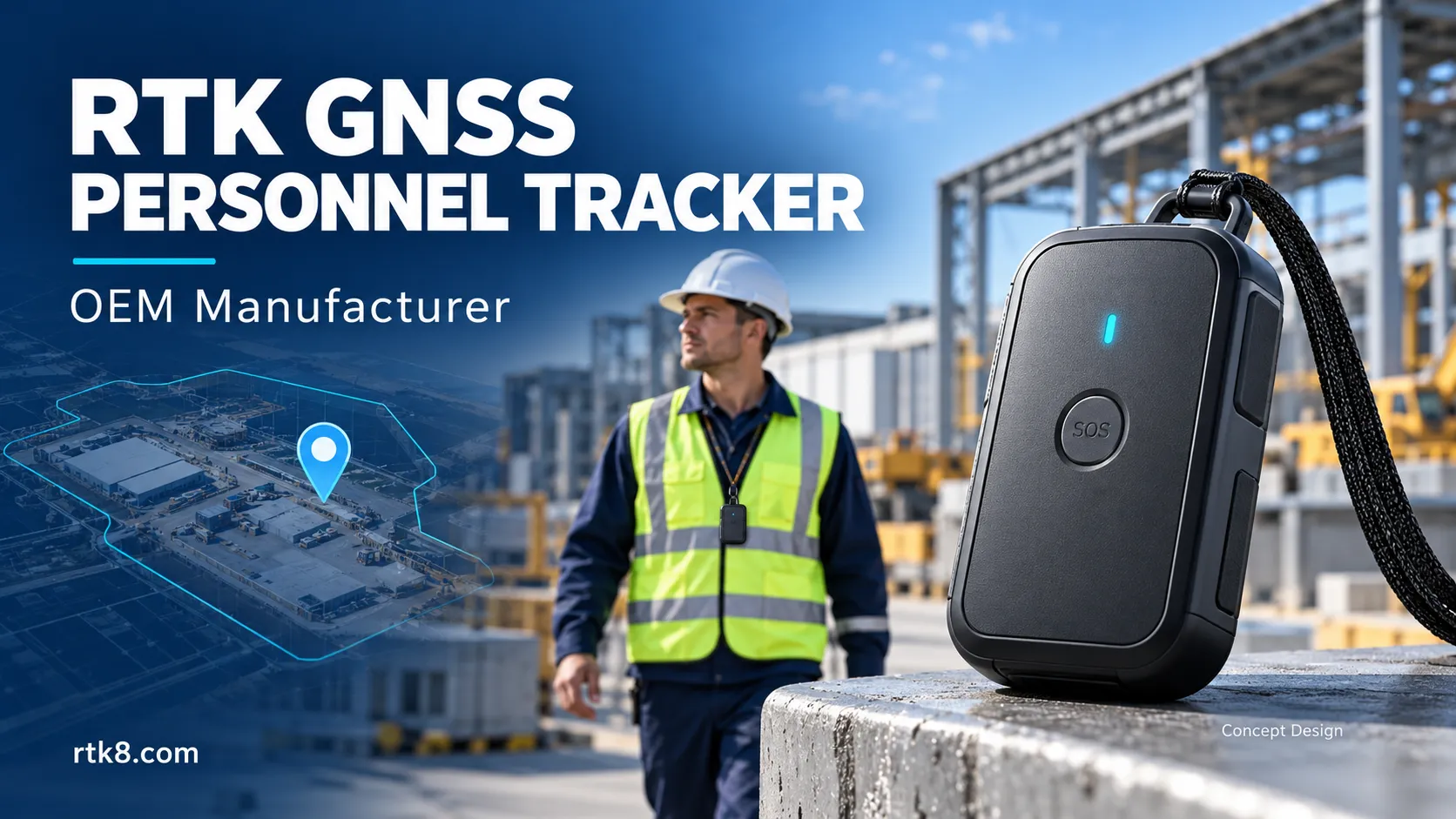
A conventional GPS badge can show the general location of an employee. Some outdoor industrial projects need more detail: whether a worker is inside an assigned work area, which side of an operational boundary they occupy, or how their route relates to a mapped site.
An RTK GNSS personnel tracker is a product option to evaluate when standard positioning does not meet the project's outdoor accuracy requirements.
For buyers choosing an RTK GNSS personnel tracker manufacturer, the key decision is how the complete solution performs: wearable hardware, correction data, communication, maps and management software.
What Is an RTK GNSS Personnel Tracker?
An RTK GNSS personnel tracker combines a high-precision GNSS receiver with a wearable enclosure and a communication interface.
RTK uses correction data and carrier-phase measurements to support high-precision positioning under suitable conditions. It requires compatible correction infrastructure; installing a receiver alone does not guarantee centimeter-level performance throughout a site.
A complete project should define:
- The wearable terminal and antenna arrangement.
- The correction source and delivery method.
- The connection used to report positions.
- The platform, maps and coordinate reference.
- Battery operation and charging.
- Optional SOS and sensor functions.
RTK8 presents RTK positioning devices, personnel badges and custom positioning solutions as part of its RTK GNSS product offering. Final model capabilities should be confirmed in the approved product specification.
Applications for a High-Precision Personnel Tracking Badge
An RTK-enabled wearable can be evaluated for outdoor projects where the location of a person needs to be related to a defined work area.
| Application | Intended use | What the pilot should verify |
|---|---|---|
| Open-air industrial yards | Review worker distribution across mapped areas | Performance beside buildings and metal structures |
| Surface mines and quarries | Locate personnel across operating zones | Coverage, terrain obstruction and reporting continuity |
| Construction sites | Compare reported positions with work-area boundaries | Coordinate alignment and changing site conditions |
| Outdoor maintenance teams | Record routes and visits to assigned locations | Wearability, battery use and communication gaps |
An outdoor RTK badge should not be assumed to provide equivalent accuracy inside buildings, tunnels or covered facilities. Indoor positioning requires a separately designed approach.
Define the Product Features Around the Deployment
A procurement brief should separate essential functions from optional development.
The positioning specification should describe the required operating environment, acceptable error, update rate and behavior when the high-precision solution is unavailable.
The wearable specification should cover mounting position, antenna orientation, device weight, enclosure dimensions, charging and expected shift duration.
Optional features may include an SOS button, motion sensing, a local buzzer or integration with attendance workflows. Each requires confirmation for the selected hardware and firmware.
A long feature list is less useful than a tested configuration that employees can wear correctly throughout a shift.
4G or LoRa Communication: Specify Both Data Paths
An RTK project has two distinct communication requirements: delivering corrections to the GNSS receiver and sending device information to the platform.
For a 4G RTK personnel tracker, cellular connectivity may support correction delivery and position uploads, depending on the architecture. Confirm coverage, modem bands, data requirements and correction-service access.
For a LoRa-based RTK design, define exactly what travels over the radio link. Sending position reports is different from delivering a continuous correction stream.
LoRa and LoRaWAN also require separate consideration. A design using a proprietary LoRa correction link should not be described as an interchangeable LoRaWAN solution.
Before selecting the radio architecture, calculate correction traffic, device-reporting traffic, update requirements and applicable regional constraints.
Correction Data Is Part of the Product Specification
A deployment may use a compatible network correction service or a local base-station arrangement.
For a network service, confirm access credentials, geographic availability, supported correction format and reconnection behavior.
For a local base, define the base position, antenna installation, power, communication and maintenance responsibilities.
If the base coordinates or site-map reference are wrong, a precise-looking position can still be offset from the intended boundary. Confirm the coordinate reference across the base, tracker, mapping system and imported site drawings.
Include correction-service charges and infrastructure costs when evaluating the total project.
Display Position Quality Alongside Location
A management platform should show more than a moving marker.
For an OEM project, request a data interface that distinguishes RTK fixed, RTK float and other supported positioning states. These states should follow the selected receiver's documented outputs.
Useful fields to specify include position timestamp, server receipt time, correction age, reported position quality, battery status and communication status.
The application should distinguish a fresh high-precision result from an older location or a degraded solution. A device can remain connected to the server while its positioning quality changes.
Design Geofence Rules Around Real Performance
A narrow digital boundary is useful only when the positioning and reporting behavior support it.
Agree on boundary margins, persistence time, location freshness and the action taken when position quality falls below the required level.
For example, a proposed rule might require several suitable observations before classifying a routine work-area exit. This is a design choice that must be tested against the required response time.
An RTK personnel tracking badge should be specified as a location and management tool. Any role in protective control requires its own validated system design.
Test the Device in Its Actual Worn Position
A GNSS receiver tested on a rooftop does not represent a badge worn against the body.
Evaluate the final enclosure, antenna and mounting position with employees standing, walking and turning. Include normal clothing and representative work equipment.
A useful acceptance test records:
- Position error against an appropriate reference.
- Availability of the required positioning state.
- Time to obtain and recover that state.
- Performance beside structures and at partial obstructions.
- Behavior during correction and reporting interruptions.
- Battery operation over the agreed shift profile.
- Platform display of delayed or degraded positions.
Agree on pass criteria before testing. Measure the complete wearable system rather than relying on the GNSS module datasheet alone.
Discuss an OEM RTK Personnel Tracker Project
When contacting an RTK GNSS personnel tracker manufacturer, provide the operating country, site layout, outdoor and indoor requirements, accuracy target, reporting rate, shift duration, quantity and platform interfaces.
Also identify the planned correction source and whether 4G, LoRa or another connection is required.
The RTK8 product range provides a starting point for discussing personnel tracking hardware and related positioning products. Request a project-specific configuration, sample evaluation plan and quotation separating devices, correction access, infrastructure and software.
The right RTK personnel tracking product is a validated combination of receiver, wearable antenna, corrections, communication and platform behavior. Define those parts together before approving a larger deployment.
Frequently Asked Questions
Is an ordinary GPS badge automatically an RTK tracker?
No. RTK requires a compatible high-precision receiver, suitable antenna, correction data and supporting firmware.
Does an RTK fixed status guarantee every position meets the project accuracy target?
No. It describes a positioning solution state. Actual performance still requires validation against a suitable reference under the intended operating conditions.
Can the same badge provide high-precision indoor tracking?
Do not assume this from RTK capability. Indoor coverage needs a separately specified positioning method and transition logic.