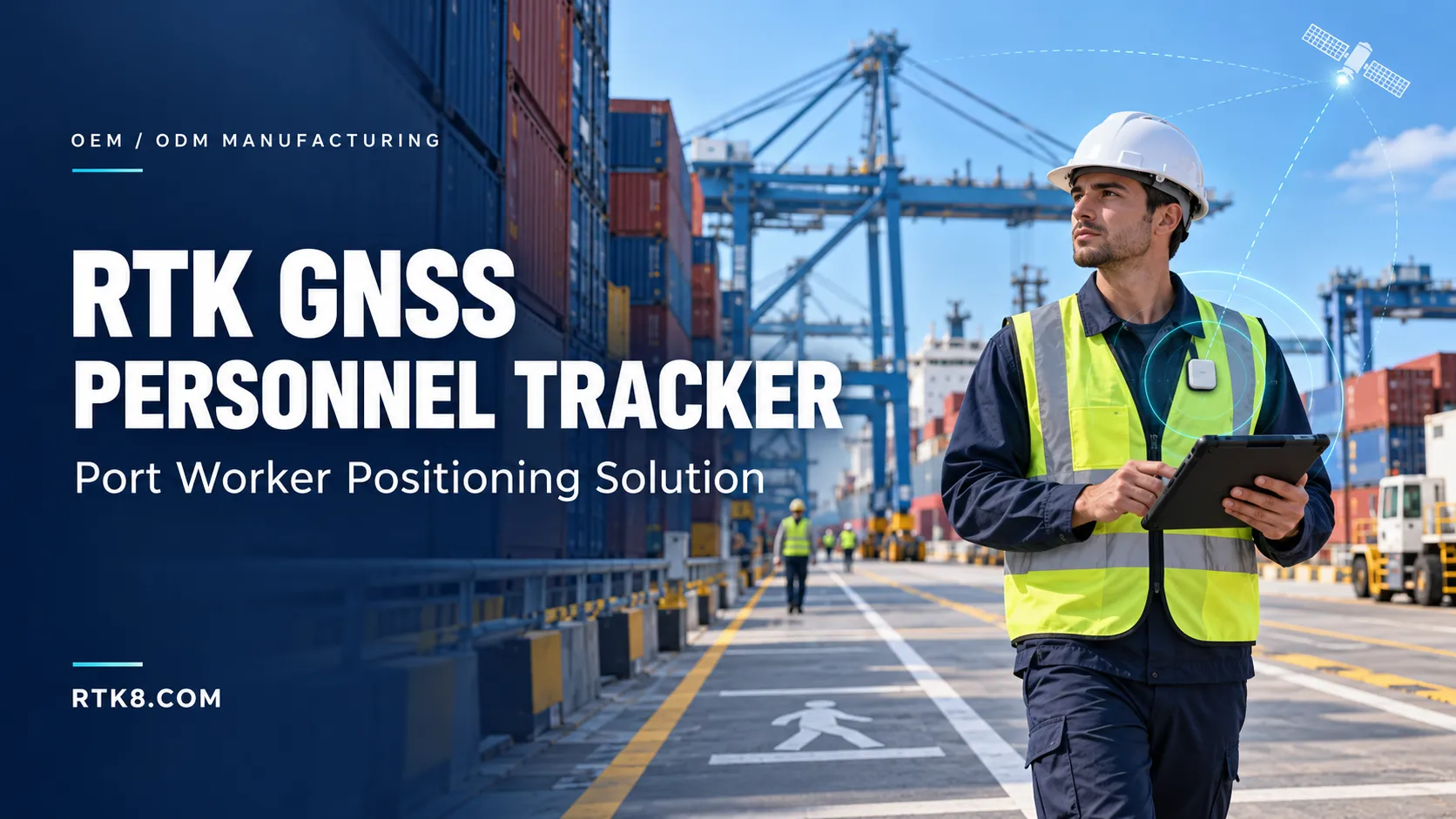
RTK GNSS Personnel Tracker Manufacturer for Port Worker Positioning
Ports and logistics terminals bring workers, trucks, containers and heavy machinery into the same operating environment.
A conventional location marker may show that a worker is inside the terminal. Operations teams may need more detail: which outdoor work zone the person has entered, whether the reported position is current and whether its accuracy is suitable for the monitoring task.
An RTK GNSS personnel tracker manufacturer can develop wearable hardware that combines high-precision satellite positioning, correction data reception, wireless communication and platform integration.
For port projects, successful deployment depends on the complete solution: the wearable device, antenna placement, correction service, communication coverage, site map and operational workflow.
What Is an RTK GNSS Personnel Tracker?
An RTK GNSS personnel tracker is a wearable positioning device equipped with a receiver capable of using Real-Time Kinematic corrections.
A proposed product configuration may include:
- Multi-band GNSS reception.
- Support for compatible RTK correction messages.
- 4G communication.
- SOS button.
- Motion sensing.
- Rechargeable battery.
- Outdoor enclosure.
- Device-status reporting.
- Platform and API integration.
These functions should be confirmed in the approved specification.
RTK uses correction information to improve positioning beyond standalone GNSS. Centimeter-level performance can be possible with suitable hardware, corrections and reception conditions, but it should not be promised continuously across an obstructed port environment. High-precision GNSS manufacturers likewise describe correction services and compatible receivers as parts of the positioning solution.
Why Consider RTK for Port Worker Tracking?
Outdoor Work-Zone Visibility
A port may contain container storage blocks, maintenance areas, vehicle staging zones and designated pedestrian routes.
High-precision positioning can help distinguish neighboring outdoor zones when the required accuracy is achieved and the site map is correctly aligned.
Before selecting hardware, define the smallest area that must be distinguished and the acceptable uncertainty near its boundary.
Restricted-Area Monitoring
The platform can compare valid reported positions with configured restricted areas.
A useful event record should include the worker assignment, location time, positioning quality and the rule that generated the notification.
Boundary monitoring should account for uncertainty. A degraded position should not be displayed with the same confidence as a validated RTK fixed solution.
Emergency Location Assistance
An SOS event can link a worker’s request for assistance with the latest available location and its timestamp.
If the device cannot obtain a fresh position, the platform should clearly identify the last known location and its age.
The emergency workflow also needs acknowledgment, escalation and an assigned response team. Device location alone does not complete the response process.
Route and Work-Area Reports
Historical records can support reviews of outdoor work-area visits, movement between zones and time spent in assigned locations.
Reports should identify periods of missing or degraded positioning rather than drawing a precise-looking route through every gap.
Proposed RTK Personnel Positioning Architecture
A port deployment can be evaluated around four connected components.
| Component | Role | Main requirement |
|---|---|---|
| Wearable RTK terminal | Calculates and reports worker position | Suitable receiver, antenna and wearable design |
| Correction source | Supplies compatible correction data | Coverage, availability and coordinate reference |
| Communication system | Carries corrections and application messages | Tested connectivity and recovery behavior |
| Management platform | Displays positions, zones, events and reports | Correct timestamps, quality states and access controls |
For a 4G-based design, the terminal may receive corrections through an NTRIP connection and upload application data through a separate service connection.
The manufacturer should specify where the NTRIP client runs, how credentials are managed and how the terminal behaves when corrections become unavailable.
Choosing the RTK Correction Source
Local Reference Station
A local base station can be evaluated when the project needs control over its correction infrastructure.
Planning should cover:
- Stable antenna installation.
- Reference coordinates.
- Power and internet availability.
- Correction-message compatibility.
- Monitoring and maintenance.
- Distribution to wearable terminals.
An incorrectly referenced base can produce positions that appear precise but are offset from the site map.
Network RTK Service
A compatible network RTK service may reduce the need to maintain a local reference station.
Check service coverage at the actual port, supported messages, account limits, subscription terms and performance during working hours.
Neither option removes the need for field testing.
Why Port Environments Need Careful Testing
Container stacks, cranes, warehouses and large metal structures can obstruct or reflect satellite signals.
A result obtained in an open car park does not establish performance between container rows.
Evaluate representative conditions:
- Open yards.
- Narrow passages between container stacks.
- Building entrances.
- Covered loading areas.
- Crane-adjacent work zones.
- Locations near large metal walls.
- Moving workers wearing normal equipment.
Record both position error and solution availability. A device that achieves excellent accuracy briefly but frequently loses the required solution may not satisfy the operational requirement.
Wearable Design Matters as Much as the GNSS Module
A receiver module specification does not automatically describe the performance of a finished badge.
The worker’s body, clothing, enclosure and battery placement can affect antenna reception.
An OEM development project should test proposed wearing positions, such as a chest badge, shoulder attachment or another approved arrangement. Compare them during normal walking, bending and work activity.
Mechanical design should also consider button accessibility, charging, cleaning, attachment security and the risk of the device becoming detached.
The final wearing method should be part of the acceptance specification.
What Positioning Information Should the Device Report?
A platform needs enough information to judge whether a location is suitable for its intended use.
Where supported, request:
- Device identity.
- Position measurement time.
- Latitude and longitude.
- Positioning solution state.
- Estimated accuracy or uncertainty.
- Correction age.
- Satellite information.
- Battery status.
- SOS and device-status flags.
- Record sequence number.
RTK fixed, RTK float and standalone GNSS positions should be distinguishable.
The map should also separate a fresh measurement from a previously stored location. When communication returns, historical uploads should retain their original measurement times.
4G and LoRa Communication Options
For a wearable design requiring continuous correction delivery, 4G can be evaluated for both correction reception and application reporting.
LoRa or LoRaWAN may be useful for compact location and status messages within a private network. However, carrying a full correction stream over such a link requires a separate engineering assessment.
Correction volume, airtime, regional constraints, latency and the number of terminals must be considered. A LoRa-enabled tracker should not automatically be described as capable of receiving continuous RTK corrections over LoRaWAN.
Define the correction path and reporting path explicitly.
Platform Functions for a Port Deployment
A proposed management platform can include:
- Worker and device assignment.
- Outdoor site map.
- Live position and data age.
- Positioning-quality indicators.
- Work-zone and restricted-area rules.
- SOS event management.
- Historical routes.
- Zone-visit reports.
- Battery and offline notifications.
- API integration.
- User permissions.
- Configuration history.
These functions should be scoped during development.
If indoor positioning is required, evaluate an additional technology and a documented transition strategy. RTK GNSS alone should not be assumed to provide reliable positioning inside warehouses or enclosed structures.
RTK Positioning and Vehicle Collision Warnings
Port buyers may ask whether a worker badge can also warn about nearby vehicles.
That is a separate system requirement.
Cloud-based location reports can support operational awareness, but their update intervals, communication delays and positioning availability must be assessed before using them for proximity warnings.
A collision-warning project may require local ranging, dedicated vehicle equipment and an independently validated alert mechanism. It should not be promised solely because the badge supports RTK.
OEM Manufacturing and Development Scope
Shenzhen Jinshengchang Technology Co., Ltd. can evaluate custom RTK personnel tracking projects covering hardware, firmware and platform integration.
The proposed development scope may include:
- GNSS receiver and antenna selection.
- Custom PCB design.
- 4G module integration.
- Correction-data handling.
- Power-management firmware.
- SOS and sensor integration.
- Enclosure and attachment design.
- Communication protocol development.
- Platform integration.
- Prototype and production testing.
- Branding and packaging.
Final capabilities, specifications and delivery scope should be confirmed after engineering evaluation.
Explore the RTK8 product range when preparing your hardware requirements.
Pilot Acceptance Before Production
Agree on measurable acceptance criteria before ordering a production batch.
Useful criteria include:
| Test area | What to evaluate |
|---|---|
| Position accuracy | Error against suitable reference points in defined conditions |
| RTK availability | Proportion of measurements achieving the required solution state |
| Recovery | Time to regain the required solution after an obstruction |
| Communication | Reporting gaps and delayed uploads |
| Wearable performance | Results with the approved wearing method |
| Battery operation | Runtime under the complete operating configuration |
| SOS workflow | Event delivery, acknowledgment and escalation |
| Zone monitoring | Correct behavior at boundaries and during degraded positioning |
Report horizontal and vertical performance separately where both matter.
A pilot should cover realistic shifts and changing site conditions, rather than relying only on a short demonstration.
Request an RTK Personnel Tracker Manufacturing Proposal
For a useful technical proposal, provide:
- Port layout and operating areas.
- Number of workers and devices.
- Required positioning accuracy and availability.
- Location update interval.
- Expected battery runtime.
- Wearing method.
- Available correction service or base-station plan.
- Cellular coverage information.
- Indoor positioning requirements.
- Platform, API and branding requirements.
RTK8 helps connect RTK product requirements with practical deployment and OEM development choices.
Visit RTK8 to discuss a wearable RTK GNSS personnel positioning solution for your port or logistics terminal.