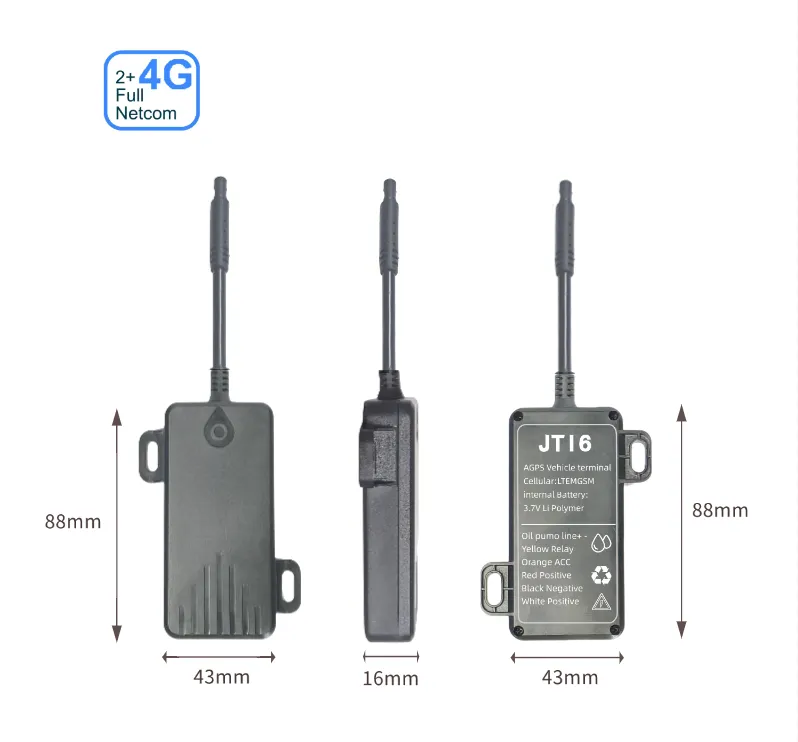
A connected vehicle tracker turns vehicle location and status records into information a fleet team can use throughout the working day.
Jinshengchang’s solution combines a wired tracking device, satellite positioning, cellular communication and a connected management platform. It helps businesses locate vehicles, review journeys and respond to configured operating events.
The product can be configured for logistics fleets, service vehicles, rental operations, vehicle-finance projects and compatible powered equipment.
Centralized Vehicle Visibility
The tracker obtains outdoor coordinates through its configured GPS and BeiDou receiver and sends records through a compatible cellular network.
The platform displays the latest reported position alongside its timestamp and available device information. Fleet teams can organize vehicles by branch, department, operating area or project.
Location age matters. A vehicle icon should clearly indicate whether its position is recent, delayed or historical, especially after a communication interruption.
4G Connectivity for Vehicle Data
A compatible 4G configuration carries location, status and supported event messages between the tracker and server.
Regional LTE bands, SIM service, roaming arrangements and local coverage must match the intended deployment.
Communication settings can be adapted to the application. Vehicles in active service may require frequent updates, while parked vehicles may use a different reporting schedule.
The final behavior depends on the selected hardware, firmware and platform.
ACC Ignition-State Monitoring
On supported configurations, an ACC input allows the tracker to detect changes in the vehicle’s ignition circuit.
This helps the platform distinguish ignition-on and ignition-off periods and apply the corresponding reporting rules.
ACC status does not independently prove that the engine is running. A vehicle may have its ignition switched on while the engine remains stopped.
Reports should therefore label ACC-derived values as ignition-on time unless another validated data source establishes engine operation.
Historical Routes and Journey Review
Recorded location points allow managers to review where a vehicle travelled and when reports were collected.
Route history can help investigate unexpected travel, check visits to operating locations and review movement between depots and customer sites.
Report quality depends on positioning validity, update frequency and data completeness. A map line between two reports represents a connection between observations; it does not prove the exact path taken between them.
Geofences and Operating Alerts
Users can create virtual areas around depots, customer facilities, construction sites or approved operating regions.
The platform can generate configured entry and exit events from suitable location data. Overspeed and external-power disconnection alerts can provide additional visibility where supported.
Boundary margins, event confirmation and notification rules should be selected to suit the fleet’s requirements.
A useful event record includes the vehicle identifier, event time, available position and supporting status information.
Vehicle Power and Disconnection Monitoring
Wired installation supplies the tracker from the vehicle electrical system within the model’s supported voltage range.
Correct wiring, circuit protection and secure connections are essential for dependable operation.
Where a backup battery is included, the device may continue operating or send a disconnection event after external power is removed. The available duration depends on battery capacity, network conditions and enabled functions.
An external-power alert identifies a power interruption. It does not by itself prove theft or deliberate tampering.
Optional Immobilization Integration
Specified models can provide a control output for an approved relay-based installation.
This function requires confirmation of the vehicle electrical design, relay rating, command authentication and operating-state checks.
A suitable implementation should prevent unsafe actuation while a vehicle is moving. Command records should distinguish a request being sent, the device acknowledging it and any independently verified change in vehicle state.
Immobilization functions should be specified separately from ordinary location tracking.
Reporting and Business Integration
Depending on the selected platform, vehicle data can support:
- Route and journey reports.
- Ignition-on duration summaries.
- Geofence entry and exit records.
- Overspeed-event reviews.
- Device communication and power-status reports.
- Estimated travel-distance calculations.
- Fleet grouping and account permissions.
GPS-derived distance is an estimate and should be distinguished from a vehicle’s odometer reading.
Fuel consumption, CAN-bus data, diagnostics and driver identification require suitable interfaces, accessories and protocol support. They are project-specific options rather than assumed functions of every tracker.
OEM and ODM Vehicle Tracking Development
Shenzhen Jinshengchang Technology Co., Ltd. provides GPS tracking hardware, embedded firmware and platform-integration services.
Customization can include communication modules, regional frequency bands, wiring harnesses, digital inputs and outputs, reporting logic, server protocols, branding and software interfaces.
For a new fleet project, provide the destination countries, vehicle types, electrical-system requirements, device quantity, reporting frequency and required alerts. These details help define the appropriate tracker configuration and installation plan.
Overview
Jinshengchang’s connected vehicle tracker combines satellite positioning, cellular connectivity and fleet-management software to help businesses monitor vehicles and review their operation. Supported configurations provide location updates, route history, ACC ignition status, geofence alerts and external-power disconnection notifications. Designed for wired vehicle installation, the solution can be adapted for commercial fleets, rental vehicles, logistics operations and equipment management. OEM/ODM services cover hardware, firmware, communication protocols and platform integration.
At the start of a working day, the fleet manager opens the platform to check the latest reported position and communication status of assigned vehicles. During a journey, each tracker collects location and supported vehicle-status information, then transmits records according to its configured schedule. An ACC connection can provide ignition-state information where installed. The platform organizes received data into vehicle locations, route history and configured events. Managers can review an overspeed event, a depot departure or an unexpected external-power interruption. After the journey, recorded routes and ignition information can support operational review. Any mileage, stop-duration or utilization report should identify how its values are calculated and how missing data is handled. Where offline storage is supported, records collected during a network interruption can be uploaded after reconnection. Historical records should retain their original acquisition time.
GPS positioning does not transmit a location by itself. Cellular, LoRaWAN or satellite connectivity must be selected for the operating environment.
What to evaluate
- Check local coverage, supported bands and reporting frequency before choosing a device.
- Confirm battery life under real conditions. Signal strength, reporting interval and temperature affect performance.
- Confirm mounting, fit, enclosure protection and maintenance with the final hardware specification.
- Confirm platform access, data ownership, integration protocol and recurring costs.
Technical checklist
| Product Category | Connected vehicle tracker |
|---|---|
| Manufacturer | Shenzhen Jinshengchang Technology Co., Ltd. |
| Installation Type | Wired vehicle installation |
| Primary Applications | Fleet, logistics, rental and commercial vehicle tracking |
| Positioning | GPS / BeiDou, according to the selected configuration |
| Cellular Communication | 4G LTE; module and regional bands subject to confirmation |
| SIM Requirements | Compatible SIM and data service |
| Main Power Supply | Vehicle power; confirm the model’s supported input-voltage range |
| Backup Battery | Availability and capacity depend on the selected model |
| Ignition Detection | ACC input on supported configurations |
| Location Reporting | Configurable time-based reporting; additional modes subject to firmware |
| Historical Data | Route and event records through the connected platform |
| Geofence Functions | Configurable entry and exit notifications |
| Supported Alerts | Overspeed, external-power disconnection and other configured events |
| Optional Control | Relay output for approved immobilization applications |
| Offline Storage | Confirm memory capacity and store-and-forward support |
| Interfaces | Confirm available digital inputs, outputs and serial interfaces |
| Platform Access | Web and mobile access according to the selected solution |
| Integration | Communication protocol and API options |
| Protection Rating | Confirm for the selected enclosure |
| Dimensions / Weight | Confirm for the selected model |
| Customization | Hardware, firmware, protocol, logo and software |
Product certifications
Certification documents must match the exact product model and target market. Verified documents, issuing bodies and validity details will be added when supplied.
Deployment
- Define the use case and local connectivity.
- Confirm device, mounting and power supply.
- Pilot in the actual environment and verify alerts.
- Agree on maintenance and access permissions.
Development & OEM
Customization may cover enclosure, branding, firmware and integration. Scope, minimum order and certification require review.
Plan a custom solution